We have compiled a list of manufacturers, distributors, product information, reference prices, and rankings for Sodium hypochlorite.
ipros is IPROS GMS ・ IPROS One of the largest technical database sites in Japan that collects information on.

Sodium hypochlorite Product List and Ranking from 10 Manufacturers, Suppliers and Companies | IPROS GMS

Last Updated: Aggregation Period:Oct 14, 2026~Nov 10, 2026
This ranking is based on the number of page views on our site.

Sodium hypochlorite Manufacturer, Suppliers and Company Rankings

Last Updated: Aggregation Period:Oct 14, 2026~Nov 10, 2026
This ranking is based on the number of page views on our site.

  1. トリイ Aichi//environment
  2. 日本化材 Nagano//Trading company/Wholesale
  3. 三谷産業イー・シー Ishikawa//Trading company/Wholesale
  4. 本町化学工業 営業本部 Tokyo//others
  5. 5 レンタブルワン Osaka//Building materials, supplies and fixtures

Sodium hypochlorite Product ranking

Last Updated: Aggregation Period:Oct 14, 2026~Nov 10, 2026
This ranking is based on the number of page views on our site.

  1. The dangerous reason for mixing sodium hypochlorite and acid [Basic Knowledge] トリイ
  2. What is the dilution calculation of sodium hypochlorite? How to calculate ppm [Basic Knowledge] トリイ
  3. Why does the concentration of sodium hypochlorite decrease? Storage and degradation [Basic Knowledge] トリイ
  4. 4 What is sodium hypochlorite? Differences from sodium chlorite [Basic Knowledge] トリイ
  5. 5 What is the basics of sodium hypochlorite? Effective chlorine, uses, regulations [Basic Knowledge] トリイ

Sodium hypochlorite Product List

1~20 item / All 20 items

Displayed results

Chlorine-based bleach Sodium hypochlorite 6% "Tea Pole Bleach"

It is an essential item for hygiene management that demonstrates powerful disinfecting and bleaching capabilities!!

This is an essential hygiene management product that exhibits powerful effects in disinfecting tableware and cooking utensils, sterilizing vegetables and fruits, and bleaching tableware, plastic cutting boards, cloths, and towels. Feature 1: Safety It uses ingredients listed in the food additive standards, so you can use it with confidence. Feature 2: Disinfection, Bleaching, and Deodorization In addition to its strong disinfection and bleaching capabilities, it also has deodorizing power. Feature 3: Simplicity It can be easily used by anyone simply by diluting it with water. Feature 4: Economy It is economical as it is cheaper compared to other disinfecting and bleaching agents. *For more details, please download the catalog PDF or feel free to contact us.

  • Other quality control and hygiene measures
  • Food store consumables
  • Other cleaning maintenance and consumables
  • Sodium hypochlorite

Added to bookmarks

Bookmarks list

Bookmark has been removed

Bookmarks list

You can't add any more bookmarks

By registering as a member, you can increase the number of bookmarks you can save and organize them with labels.

Free membership registration

Sodium hypochlorite 0.05% formulation "Sunlack 500"

A disinfectant effective against various viruses! Suitable for handrails, doorknobs, elevator buttons, and more.

"Sunlack 500" is a 0.05% sodium hypochlorite formulation made from raw materials actually used in tap water. Quality control is thoroughly implemented at our own factory that manufactures JWWA certified products. It is adjusted using high-quality sodium hypochlorite and pure water to enhance its shelf life. It can be used as is without dilution. To ensure safe and secure usage, we provide various handling materials. [Features] ■ Made from raw materials actually used in tap water ■ Reliable quality assurance ■ High shelf life ■ Easier to use ■ Can be used as is without dilution *For more details, please refer to the PDF materials or feel free to contact us.

  • Disinfecting and antibacterial products
  • Sodium hypochlorite

Added to bookmarks

Bookmarks list

Bookmark has been removed

Bookmarks list

You can't add any more bookmarks

By registering as a member, you can increase the number of bookmarks you can save and organize them with labels.

Free membership registration

Sodium hypochlorite 0.1% formulation "Sunlack 1000"

Products manufactured in our own factory! We have analysis results from third-party analysis organizations available.

"Sanlac 1000" is a disinfectant effective against various viruses, including norovirus. It is made from sodium hypochlorite, which is actually used in tap water, ensuring safety and security. We adjust high-quality sodium hypochlorite at our own factory to enhance its shelf life. [Features] ■ Safe and secure ■ Reliable quality assurance ■ High shelf life *For more details, please refer to the PDF document or feel free to contact us.

  • Disinfecting and antibacterial products
  • Other cleaning agents
  • Sodium hypochlorite

Added to bookmarks

Bookmarks list

Bookmark has been removed

Bookmarks list

You can't add any more bookmarks

By registering as a member, you can increase the number of bookmarks you can save and organize them with labels.

Free membership registration

Sodium hypochlorite 0.1% formulation "Sunlack 1000"

Gathering analysis results from third-party analysis organizations! Disinfectants suitable for various virus countermeasures.

"Sunluck 1000" is an easy-to-use sodium hypochlorite solution with a concentration of 0.1%, equipped with a convenient tap. It is made from sodium hypochlorite that is actually used in tap water. Quality control is thoroughly implemented at the factory that manufactures JWWA certified products. By using high-quality sodium hypochlorite and pure water, we enhance its stability and provide various handling instructions to ensure safe and secure usage. [Features] ■ Safe and secure ■ Reliable quality assurance ■ High stability ■ More user-friendly *For more details, please refer to the PDF document or feel free to contact us.

  • Other safety and hygiene products
  • Sodium hypochlorite

Added to bookmarks

Bookmarks list

Bookmark has been removed

Bookmarks list

You can't add any more bookmarks

By registering as a member, you can increase the number of bookmarks you can save and organize them with labels.

Free membership registration

Food additive / Sodium hypochlorite "Fresh Lux"

Powerful triple effect of sterilization, bleaching, and deodorization! This product is less likely to cause machine troubles such as bacterial growth.

"Fresh Lux" is a low-salt sodium hypochlorite produced under strict quality control, offering excellent stability. We offer "Fresh Lux F6" with an effective chlorine content of over 6% and "Fresh Lux F12" with over 12%. Its effects are quick and reliable, and it is also economically advantageous, making it widely used for disinfection, bleaching, and deodorization in various fields. 【Features】 ■ Delivers quick and reliable results ■ Low salt content with minimal impurities ■ Less likely to cause machine troubles such as sterilization issues ■ Highly economical as it is effective even in small quantities *For more details, please refer to the PDF materials or feel free to contact us.

  • Food environmental hygiene/contamination prevention equipment
  • Sodium hypochlorite

Added to bookmarks

Bookmarks list

Bookmark has been removed

Bookmarks list

You can't add any more bookmarks

By registering as a member, you can increase the number of bookmarks you can save and organize them with labels.

Free membership registration

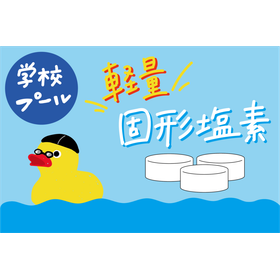
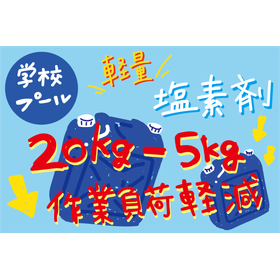
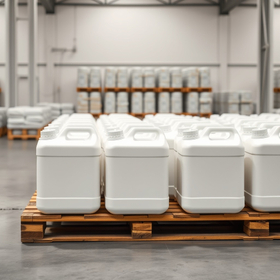
The sodium hypochlorite pool chemicals are heavy and the work is difficult.

Introducing two methods to lighten heavy pool chemicals in a column format!

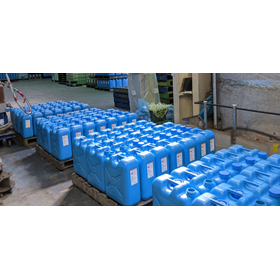
The chemicals managed by those in charge of the pool are familiar substances. It is a liquid called sodium hypochlorite (bleach), which has a property of being heavier than water. Generally, it comes in a poly tank weighing about 20 to 25 kg, making it very heavy. In the past, we received many comments from school pool managers, such as, "The chemical poly tanks are heavy; is there anything we can do about it?" *For more details on the column, you can view it through the related links. For more information, please feel free to download the PDF or contact us.

  • Chemicals
  • Vocational Training/Technical School
  • Coagulant
  • Sodium hypochlorite

Added to bookmarks

Bookmarks list

Bookmark has been removed

Bookmarks list

You can't add any more bookmarks

By registering as a member, you can increase the number of bookmarks you can save and organize them with labels.

Free membership registration

Lightweight Sodium Hypochlorite | Eliminating the Heavy Labor of Pool Water Quality Management [With Case Studies]

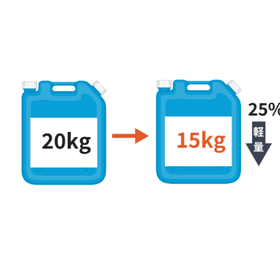
For those struggling with heavy 20kg containers and hazardous liquid splashes! We solve this with a 15kg lightweight design, ensuring safety in chemical handling and reducing the burden.

Do you have any concerns regarding the handling of sodium hypochlorite at pool or water treatment facilities? - The conventional 20kg containers are too heavy, making transportation and injection work a heavy burden for specific staff. - When pouring the liquid, there is a "gobble" splash (liquid splatter), raising concerns about skin contact, clothing discoloration, and labor accident risks. - It cannot be used up in one go, leading to anxiety over accidents during storage and handling management. The lightweight sodium hypochlorite (15kg) fundamentally resolves these issues at the work site. ◇ Excellent operability due to 25% weight reduction The weight is reduced to 15kg while maintaining the same specifications as the conventional 20kg container. This minimizes the burden of carrying and allows various workers to handle it smoothly. ◇ Stable design that reduces liquid splatter risk The weight reduction stabilizes the balance during pouring. It suppresses the "gobble" splashing phenomenon and prevents chemical contact accidents. ◇ Optimization of management burden and introduction costs By handling smaller quantities, storage risks are reduced. The introduction cost can also be offered at the same level as the conventional 20kg product. We are currently offering free case studies to improve work safety and eliminate burdens.

  • Local government
  • Water Treatment Chemicals
  • Water Quality Analysis Equipment
  • Sodium hypochlorite

Added to bookmarks

Bookmarks list

Bookmark has been removed

Bookmarks list

You can't add any more bookmarks

By registering as a member, you can increase the number of bookmarks you can save and organize them with labels.

Free membership registration

Can sodium hypochlorite, which is difficult to transport, be made lighter? A case study of school pools.

We can handle hazardous substances (sodium hypochlorite) safely!

"Sodium hypochlorite," necessary for maintaining pool water quality. Its handling has increasingly become a burden on the field in recent years. - The conventional 20kg containers are heavy, making it particularly difficult for female staff to carry. - Due to being a liquid, the contents tend to slosh around during transport, posing a danger. - There is a risk of clothing being bleached or discolored if spilled. - It cannot be used up in one go, requiring careful storage. In light of these challenges, we have received inquiries asking, "Can we make it safer and easier to handle?" Please refer to the downloadable materials for more details on our proposal.

  • Vocational Training/Technical School
  • Disinfectant
  • Other sterilization, disinfection and disinfection equipment
  • Sodium hypochlorite

Added to bookmarks

Bookmarks list

Bookmark has been removed

Bookmarks list

You can't add any more bookmarks

By registering as a member, you can increase the number of bookmarks you can save and organize them with labels.

Free membership registration

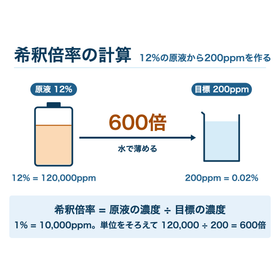
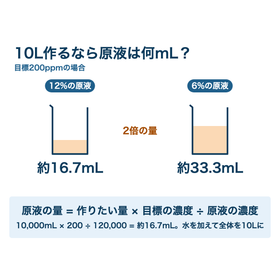
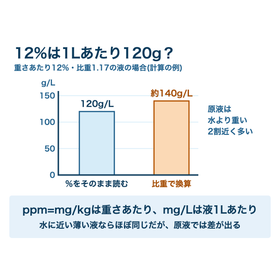
What is the dilution calculation of sodium hypochlorite? How to calculate ppm [Basic Knowledge]

How much should you dilute a 12% solution to make 200 ppm? This explains the dilution calculation formula and examples used in business, precautions for making in advance, and guidelines for concentrations based on different uses.

Sodium hypochlorite is sold as a high-concentration product and is a chlorine-based agent used after dilution. On-site, the concentrated solutions labeled "12%" and "6%" are diluted with water to the appropriate concentration for the intended purpose. ■ What is the relationship between % and ppm? ppm is a unit that represents one part per million, and 1% corresponds to 10,000 ppm. Therefore, 12% is 120,000 ppm, and 6% is 60,000 ppm. The concentration of disinfectants may also be indicated alongside values such as 0.02% (200 ppm) and 0.1% (1,000 ppm). Additionally, concentrations may be expressed in mg/L, and here we will approximate 1 ppm as 1 mg/L. ■ How much should I dilute? The dilution factor is calculated by dividing the concentration of the original solution by the target concentration. Ensure that the units are consistent when performing the calculations. 1. From 12% to 200 ppm: 120,000 ÷ 200 = 600 times 2. From 6% to 200 ppm: 60,000 ÷ 200 = 300 times 3. From 12% to 1,000 ppm: 120,000 ÷ 1,000 = 120 times Even for the same 200 ppm, the 6% original solution requires twice the amount compared to the 12% solution. Please feel free to consult us first.

  • 024_main.png
  • 024_sub.png
  • Water Treatment Chemicals
  • Disinfectant
  • Residual chlorine meter
  • Sodium hypochlorite

Added to bookmarks

Bookmarks list

Bookmark has been removed

Bookmarks list

You can't add any more bookmarks

By registering as a member, you can increase the number of bookmarks you can save and organize them with labels.

Free membership registration

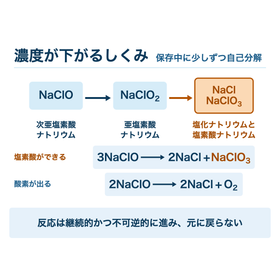
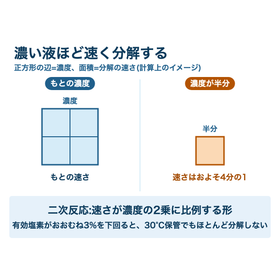
Why does the concentration of sodium hypochlorite decrease? Storage and degradation [Basic Knowledge]

Where does the reduced effective chlorine go? We will organize the reaction equations for decomposition, the reasons why the rate of decomposition changes with concentration, measures against temperature and light, and indicators to notice degradation.

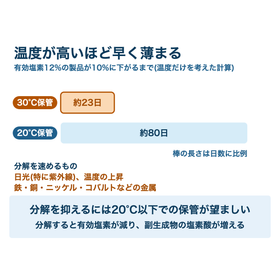
Sodium hypochlorite is an important chemical that should be treated as a "perishable item." As time passes, the effective chlorine decreases, and other substances increase in its place. Since decomposition during storage is unavoidable, knowing how it decomposes can clarify the key points for management. ■ Where does the effective chlorine go? Sodium hypochlorite gradually self-decomposes during storage, converting through sodium chlorite to sodium chloride and sodium chlorate, with oxygen also being produced as a byproduct. The reactions can be represented by the following two equations: 1. Reaction producing chlorate: 3NaClO → 2NaCl + NaClO3 2. Reaction producing oxygen: 2NaClO → 2NaCl + O2 ■ Does the reduced amount return? No, it does not. This reaction proceeds continuously and irreversibly, so the concentration of sodium chlorate continues to rise. ■ Decrease in effective chlorine and increase in chlorate In products with 12% effective chlorine, there is a relationship where for every 1% decrease in effective chlorine, chlorate increases by approximately 3,500 mg/kg. Please feel free to consult with us first.

  • 049_main.png
  • 049_sub.png
  • Water Treatment Chemicals
  • Disinfectant
  • Chemicals
  • Sodium hypochlorite

Added to bookmarks

Bookmarks list

Bookmark has been removed

Bookmarks list

You can't add any more bookmarks

By registering as a member, you can increase the number of bookmarks you can save and organize them with labels.

Free membership registration

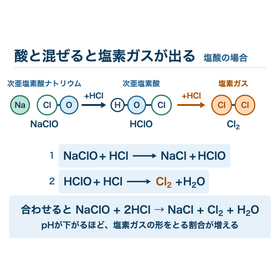
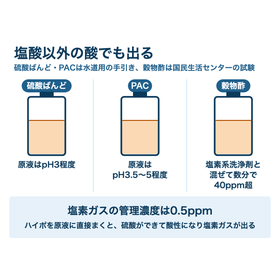
The dangerous reason for mixing sodium hypochlorite and acid [Basic Knowledge]

Is hydrochloric acid the only danger? This summarizes the mechanism of reactions that produce chlorine gas, examples of labor accidents caused by mix-ups, and the measures the government presents to prevent mixing.

Incidents of chlorine gas generation due to the mixing of sodium hypochlorite solutions and acidic solutions have occurred almost every year. The former is used for disinfection and bleaching, while the latter is used for cleaning and water treatment, leading to many workplaces having both types of tanks. Misunderstandings or incorrect refills can trigger accidents. ■ Why does chlorine gas emerge? The form in which effective chlorine exists is influenced by pH; as pH decreases, it transitions from hypochlorite ions to hypochlorous acid, and then to chlorine gas. When an acid is added to an alkaline product, the pH drops, causing this sequence of transformations. In the case of hydrochloric acid, it can be expressed as follows: 1. NaClO + HCl → NaCl + HClO 2. HClO + HCl → Cl2 + H2O ■ Combining the two equations When combined, they yield "NaClO + 2HCl → NaCl + Cl2 + H2O." As acidity increases, the proportion of chlorine gas formation rises. The second equation represents the reverse reaction where chlorine reacts with water to produce hypochlorous acid and hydrochloric acid. Please feel free to consult us first.

  • 050_main.png
  • 050_sub.png
  • Water Treatment Chemicals
  • Chemicals
  • Disinfectant
  • Sodium hypochlorite

Added to bookmarks

Bookmarks list

Bookmark has been removed

Bookmarks list

You can't add any more bookmarks

By registering as a member, you can increase the number of bookmarks you can save and organize them with labels.

Free membership registration

Sodium hypochlorite "Disinfecting Wiper Dia 200"

A wiper for environmental maintenance that allows for disinfection and cleaning!

Sodium hypochlorite "Disinfection Wiper DIA200" is a wiper for environmental maintenance that enables disinfection and cleaning. It is widely used in food factories, hospitals, hotels, restaurants, childcare facilities, elderly care facilities, event halls, and more. 【Features】 ■ Sodium hypochlorite ■ Low irritation and low corrosion ■ Maintains concentration for 2 years in an unopened state (stored in a cool, dark place) ■ Easy-to-handle pouch type ■ Dedicated non-woven fabric sheet *For more details, please refer to the PDF document or feel free to contact us.

  • Wipers
  • Sodium hypochlorite

Added to bookmarks

Bookmarks list

Bookmark has been removed

Bookmarks list

You can't add any more bookmarks

By registering as a member, you can increase the number of bookmarks you can save and organize them with labels.

Free membership registration

Sodium hypochlorite "Autolacron Tenner"

It can typically be diluted with tap water to 0.1-0.2% for use as a disinfectant. It can be used in food factories, food-related businesses, kitchens, and medical institutions.

Sodium hypochlorite "Autolacron Tenner" is a low-salt sodium hypochlorite. It is easy to use in food factories, food-related businesses, kitchens, and medical institutions, and is particularly suitable for norovirus prevention. <Product Features> - Packaging: 2kg/box - Concentration: 12w% - Pack-in-box type *For more details, please download the PDF or contact us.

  • Chemicals
  • Sodium hypochlorite

Added to bookmarks

Bookmarks list

Bookmark has been removed

Bookmarks list

You can't add any more bookmarks

By registering as a member, you can increase the number of bookmarks you can save and organize them with labels.

Free membership registration

What is the basics of sodium hypochlorite? Effective chlorine, uses, regulations [Basic Knowledge]

What is included in sodium hypochlorite handled on-site? An explanation of how effective chlorine is represented, the fields in which it is used, relevant laws, and the basics of handling it.

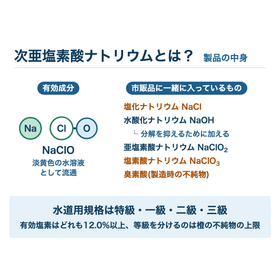
Sodium hypochlorite (NaClO) is a chlorine-based chemical used for disinfection and bleaching, and it is distributed in the workplace as a pale yellow aqueous solution. It is also a component found in household chlorine-based bleaches. It is handled as an aqueous solution with an effective chlorine concentration of 6-15% and is used for bleaching fibers and pulp, water treatment, and as a food additive. ■ Is there only one type of product? Commercial products for water supply contain, in addition to this substance, sodium chloride, sodium hydroxide (caustic soda) to suppress decomposition, sodium chlorite, sodium chlorate, and an aqueous solution containing bromate, which is an impurity from manufacturing. It is not a pure single component. ■ How is the grade determined? The standards for water supply (JWWA K 120) include special grade, first grade, second grade, and third grade. ■ Impurities determine the grade The effective chlorine content is 12.0% or more for all grades, and the grades are differentiated by the upper limits of impurities such as chlorate, bromate, and sodium chloride. For example, the upper limit for bromate is 10 mg/kg for special grade and 100 mg/kg for third grade. If you have any questions about choosing the appropriate grade or concentration for your application, please feel free to consult us.

  • 012_main.png
  • 012_sub.png
  • Water Treatment Chemicals
  • Disinfectant
  • Chemicals
  • Sodium hypochlorite

Added to bookmarks

Bookmarks list

Bookmark has been removed

Bookmarks list

You can't add any more bookmarks

By registering as a member, you can increase the number of bookmarks you can save and organize them with labels.

Free membership registration

Reasons for the decrease in effective chlorine in sodium hypochlorite for disinfection [Basic Knowledge]

Does the concentration decrease just by leaving the same product out? The mechanism of sodium hypochlorite disinfection used in business and storage precautions.

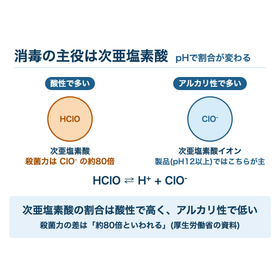
One of the chlorine-based disinfectants used in various business settings, such as for disinfecting tap water and pool water, as well as for sterilizing raw materials in cooking facilities, is a liquid containing sodium hypochlorite (NaClO) as its active ingredient. Commercially available tap water products typically have an effective chlorine content of over 12% and are a pale yellow, transparent liquid with a pH of over 12. This agent is primarily used for chlorine disinfection in water supply systems. ■ Is hypochlorous acid the main player in disinfection? Due to its alkaline nature, this agent mainly exists as hypochlorite ions. The proportion of hypochlorous acid is high in acidic conditions and low in alkaline conditions, and the bactericidal power of hypochlorous acid is about 80 times that of hypochlorite ions. ■ The concentration used varies by application! 1. Vegetables and fruits served without heating in large-scale cooking facilities: 200 mg/L for 5 minutes, or 100 mg/L for 10 minutes. 2. Swimming pools: A free residual chlorine level of 0.4 mg/L or higher, but below 1.0 mg/L is desirable. ■ Dilute the concentrate for use The product is sold at high concentrations and is typically diluted for use in soaking and other applications. It should be diluted from the concentration of the original solution to a level suitable for the intended use. Please feel free to consult us first.

  • 013_main.png
  • 013_sub.png
  • Water Treatment Chemicals
  • Disinfectant
  • Residual chlorine meter
  • Sodium hypochlorite

Added to bookmarks

Bookmarks list

Bookmark has been removed

Bookmarks list

You can't add any more bookmarks

By registering as a member, you can increase the number of bookmarks you can save and organize them with labels.

Free membership registration

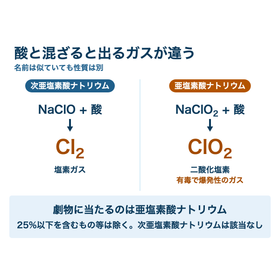
What is sodium hypochlorite? Differences from sodium chlorite [Basic Knowledge]

What changes with just one letter difference? The chemical formulas and legal treatments are for different substances. We will compare the properties of sodium hypochlorite and sodium chlorite.

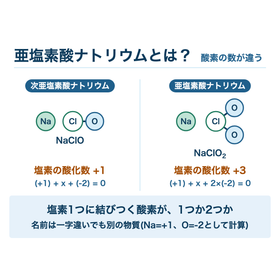
Sodium hypochlorite is a chlorine-based compound used for bleaching and disinfection. Its main applications include bleaching of textiles and food, as well as surface treatment of semiconductors. In Japan, it is designated as one of the bleaching agents and disinfectants for food additives. As a substance, it is a slightly hygroscopic white crystal or flake. ■ What is the difference between having "hypo" and not having it? When arranged in chemical formulas, the differences become clear. 1. Sodium hypochlorite: NaClO 2. Sodium chlorite: NaClO2 ■ The number of oxygens and the oxidation state of chlorine The difference lies in whether one or two oxygens are bonded to one chlorine. When calculating with sodium at +1 and oxygen at -2, the oxidation state of chlorine is +1 in sodium hypochlorite and +3 in sodium chlorite. Although the names differ by one character, they are distinct substances. ■ What is the history as a food additive? Sodium chlorite was designated as a food additive in 1948, while sodium hypochlorite was designated in 1950. Both have been used as chlorine compounds for a long time, but the regulations for their use are significantly different. Please feel free to consult us first.

  • 027_main.png
  • 027_sub.png
  • Water Treatment Chemicals
  • Chemicals
  • Disinfectant
  • Sodium hypochlorite

Added to bookmarks

Bookmarks list

Bookmark has been removed

Bookmarks list

You can't add any more bookmarks

By registering as a member, you can increase the number of bookmarks you can save and organize them with labels.

Free membership registration

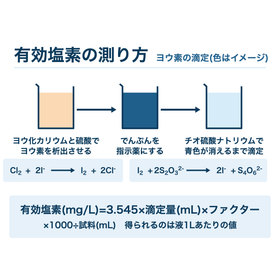
What is effective chlorine concentration? How to measure it and how to read the display [Basic knowledge]

What is 12%? We will explain what is being counted as effective chlorine, the differences between %, ppm, and mg/L, and the mechanism of titration to check effective chlorine.

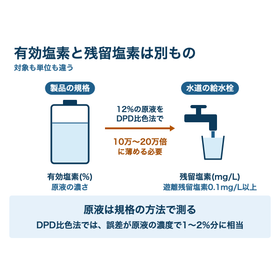
The specifications and purchase specifications for chlorine-based agents state concentrations such as "effective chlorine 12.0% or more." Even with the same "%" or "ppm," if you do not know what the value represents as a ratio of what to what, you may misinterpret it. First, let's look at the meaning of the term effective chlorine. ■ What does effective chlorine measure? The chemical formulas for effective chlorine include chlorine (Cl2), hypochlorous acid (HClO), and hypochlorite ion (ClO-). The ratio of these three forms varies depending on the pH of the liquid. Regardless of their form, the concept of effective chlorine is to count them collectively as a measure of chlorine. ■ Is 12% a "minimum" value? In the standards for sodium hypochlorite used for drinking water, effective chlorine is defined as "12.0% or more," regardless of grade, which sets a lower limit. This does not mean a solution that is exactly 12%, but rather that it should not fall below that level. Some purchase specifications may require a quality of 6.0% or more. It is also important to note that effective chlorine may decrease during storage. Please feel free to consult us first.

  • 060_main.png
  • 060_sub.png
  • Water Treatment Chemicals
  • Disinfectant
  • Residual chlorine meter
  • Sodium hypochlorite

Added to bookmarks

Bookmarks list

Bookmark has been removed

Bookmarks list

You can't add any more bookmarks

By registering as a member, you can increase the number of bookmarks you can save and organize them with labels.

Free membership registration

Low-sodium sodium hypochlorite

You can dilute it according to your needs!

Our company handles "low-salt sodium hypochlorite," which is widely used as a disinfectant for drinking water, disinfecting fruits and vegetables, manufacturing and processing equipment, utensils, pools, baths, sewage, and for stain removal and bleaching. It can be used extensively in homes, offices, restaurants, hospitals, and medical facilities for infection control, disinfecting and bleaching kitchen items such as dishes, trays, knives, and cutting boards, as well as for disinfecting and deodorizing drains, walls, floors, and bathrooms. [Applications] ■ Disinfection of water (drinking water, pools, drainage) ■ Disinfection of fresh vegetables and fruits, and cooking utensils ■ Disinfection of bathrooms, bathtubs, toilets, etc. ■ Bleaching and stain removal (juice, ink, etc.) *For more details, please download the PDF or feel free to contact us.

  • Other cleaning tools
  • Other consumables
  • Sodium hypochlorite

Added to bookmarks

Bookmarks list

Bookmark has been removed

Bookmarks list

You can't add any more bookmarks

By registering as a member, you can increase the number of bookmarks you can save and organize them with labels.

Free membership registration

Disinfectant and deodorizer Stable sodium hypochlorite 【Saber Oxy】

A disinfectant spray that is safe to use with consideration for people, pets, and the environment.

Stabilized sodium hypochlorite "Saber Oxyin" is a disinfectant spray that can be safely used with consideration for people, pets, and the environment. It can be used in various settings without restriction. This product is a stabilized sodium hypochlorite product that has been approved by the Ministry of Health, Labour and Welfare as a food additive, disinfectant, and bactericide. It is a product specialized for safety and effectiveness. It is completely different from the products criticized in the media, so you can use it with confidence. 【Features】 ◆ Instantly inactivates viruses and fungi ◆ Breaks down odors and deodorizes ◆ Effective against cedar pollen and house dust *Inactivation effect tests against bacteria and viruses have been conducted. For detailed specifications, please download the PDF. Feel free to contact us.

  • サブ画像.png
  • Other safety and hygiene products
  • Other office supplies
  • others
  • Sodium hypochlorite

Added to bookmarks

Bookmarks list

Bookmark has been removed

Bookmarks list

You can't add any more bookmarks

By registering as a member, you can increase the number of bookmarks you can save and organize them with labels.

Free membership registration

Instant deodorization of the eight major odors designated by the Ministry of the Environment! Stable concentration sodium hypochlorite.

Powerful deodorization of bothersome unpleasant odors! A stable type of sodium hypochlorite that is friendly to people and has obtained certification as a food additive. *Product information is currently available!

"Concentration-stable sodium hypochlorite" is a component that remains stable without a decrease in effective ingredients during long-term storage, adapting to various environments. It is weakly alkaline and non-volatile, so there is no concern about skin irritation, dryness, or pain, and it does not corrode or bleach metal products or fabrics, making it suitable for various usage locations. Additionally, it effectively disinfects without taking time, achieving a high instant disinfection rate against seasonal infectious diseases and is also effective against bacteria and viruses suspended in the air. It powerfully and instantly deodorizes unpleasant odors, including the eight major odors designated by the Ministry of the Environment. 【Features】 ■ Weakly alkaline and non-volatile ■ Safe and secure for people and the environment, non-polluting ■ Non-corrosive and non-bleaching ■ No unpleasant odor typical of chlorine-based products ■ Instant and powerful disinfection ■ Instant and powerful deodorization *For more details, please refer to the catalog or feel free to contact us.

  • others
  • Sodium hypochlorite

Added to bookmarks

Bookmarks list

Bookmark has been removed

Bookmarks list

You can't add any more bookmarks

By registering as a member, you can increase the number of bookmarks you can save and organize them with labels.

Free membership registration

Related Categories of Sodium hypochlorite